SHARED LIVING

Would you share your toothbrush?
Co-design project
You want to live in a shared community but need to plan for practicalities for such a living. How would you begin planning? 
Well, this Toolkit would help you find your answers by engaging in different activities and experiences. You are building, exploring and raising practical concerns and considerations together. 

Team

Linea Bendtsen 
Elizabeth Matkiewicz
Tirsa Rosalba Ramos-Pedersen, 
Jonas Stengel
Valentina Ustinova

Problem

How can we support different communities of people to envision, create, and develop new forms of shared living that are both socially and environmentally sustainable?

Process

We began with literature research, interviews, field research, and brainstorming.
After the toolkit's prototype was created, the design team conducted a series of facilitated workshops. The results of these workshops proposed to include methods such as cultural probes, roleplay, scenarios, and workshops in the final version of the toolkit.

Solution

The Toolkit consisting of a series of workshops with cultural probes in between, tackling Practicalities, Conflicts, and Emotions to different extend.

PROJECT IN NUMBERS

5

Interaction Designers were involved in this project

8

Weeks lasted the project

2

Workshops were held during this project

Solution

The Toolkit consisting of a series of workshops with cultural probes in between, tackling Practicalities, Conflicts, and Emotions to different extend.

PROCESS

My Responsibilities

Co-facilitation and documenting of the workshops
Prototyping the contents of the toolkit with other teammates
Field research

Tools

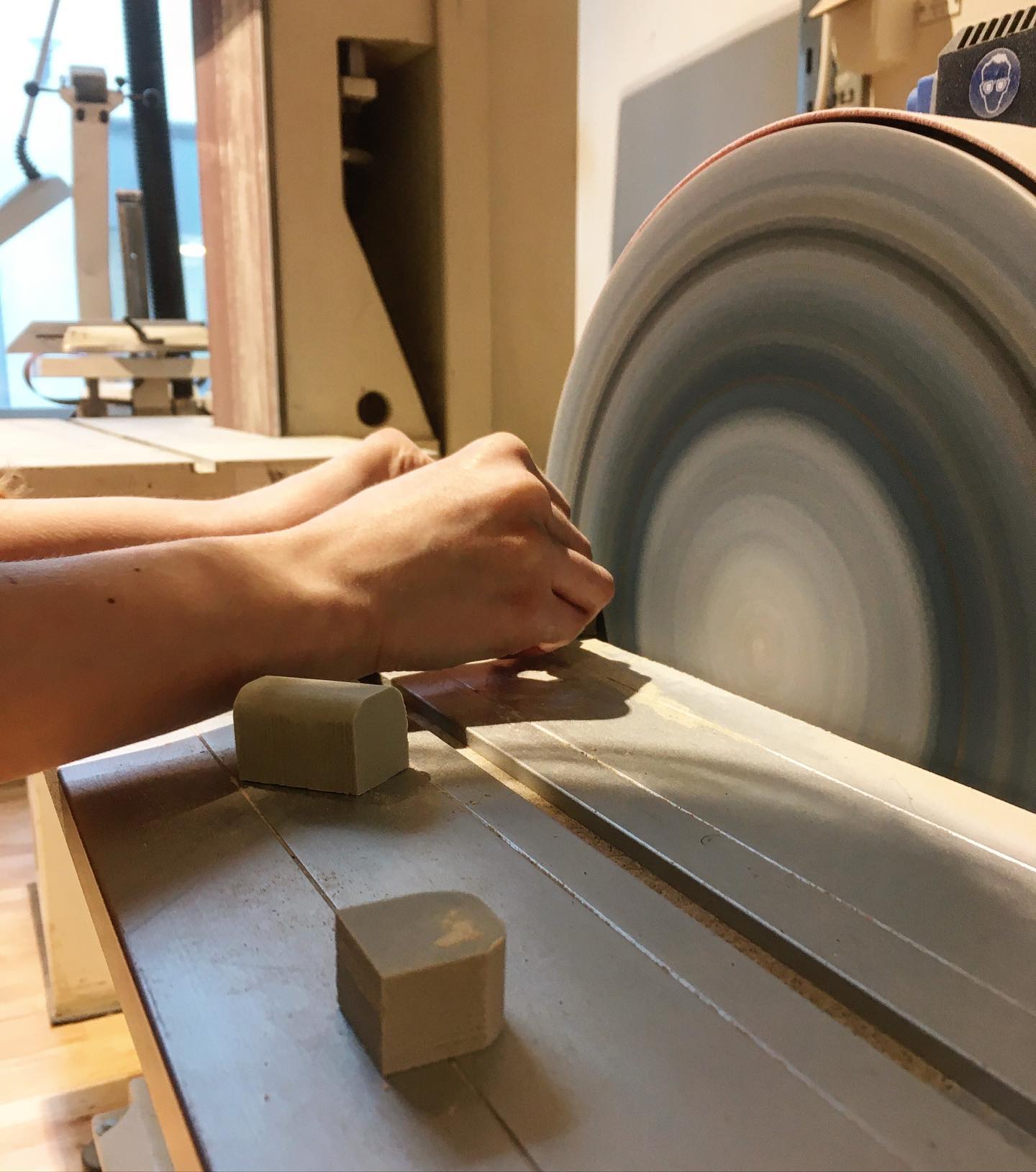
Sanding machinery
Lazercutting machine
Pen & paper
Microsoft Word
Adobe Photoshop

Target Group

• People who are trying to plan their way of life.
• People who are curious about living in a shared space but lack knowledge about it.
• People who need to spark imagination about practicalities, conflicts, and emotions that could come up in a shared living space.

Stakeholder

K3 Malmö University

Prototyping & Prep for Workshops

We began the process with debriefing and really undersatnding what shared living meant for us. We shared stories, articles, went to the exhibition in Malmö Form and Design Centre, interviewed experts and people who lived in communal living and also visited an eco-community in Denmark.

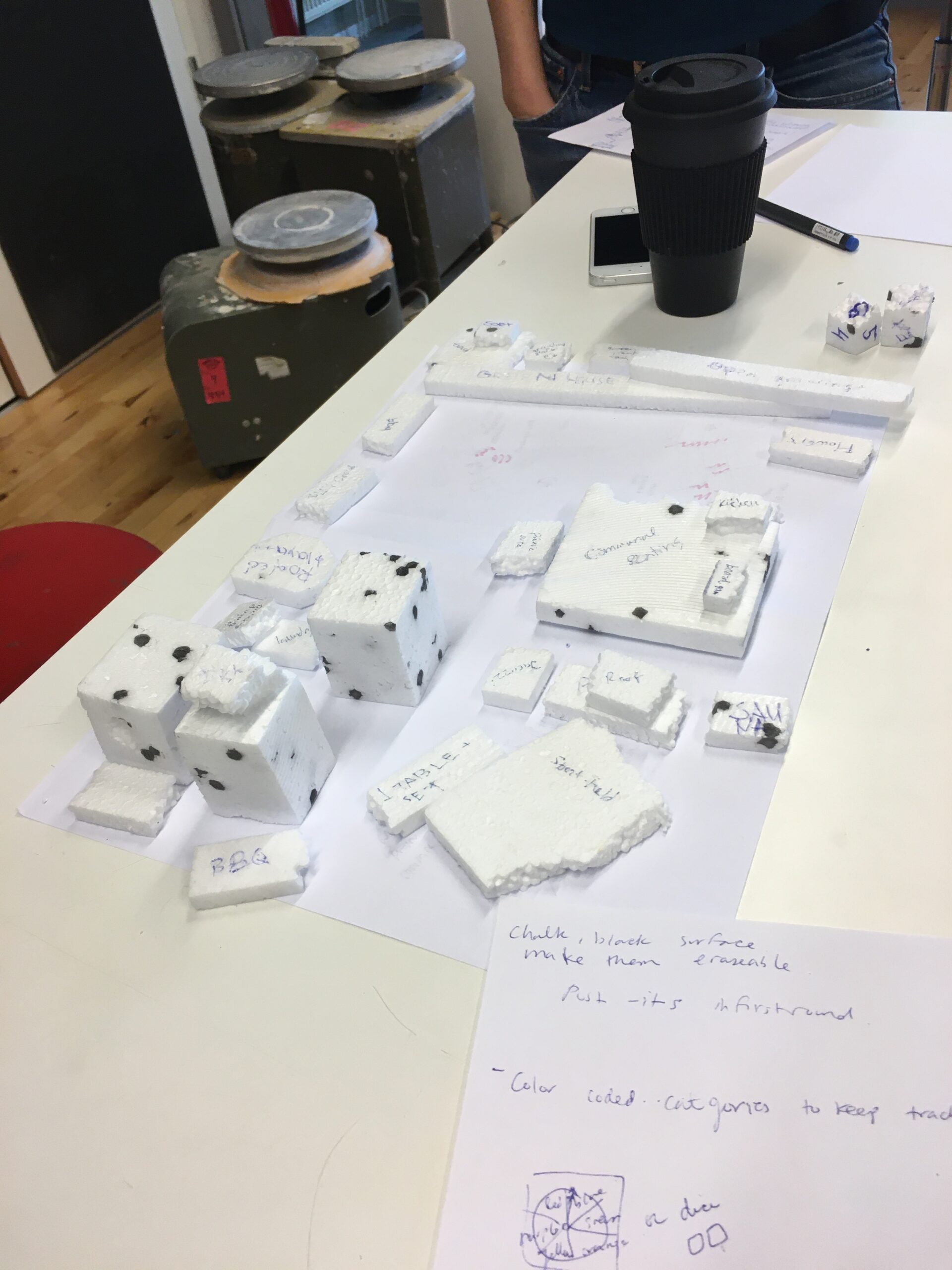
In parallel, we were ideating on what activities ti include to the workshop. One of the activities was inspired by the exhibition visit, but we needed more. Our stakeholder recommended to hit the workshop space and start playing with tangible materials. So we played with frigolit due to its tangibility and the ability to break easily into different pieces. 

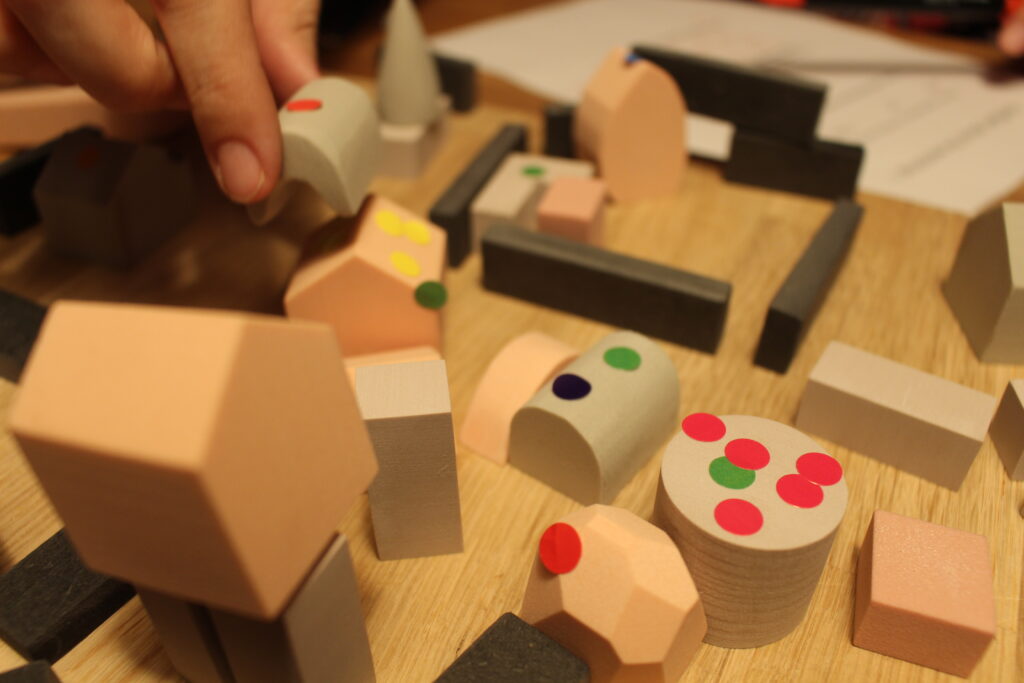
The first activity tried with frigolit pieces was a task to build an apartment, where all the team members were living. The problem with that activity was the absence of turns and not everyone got to have their voice heard. Then the die with turns was implemented, the number would show how many elements a participant could change. Soon after that the setting was changed due to the project setting to a new task of building a community on a given field of A3 paper. 
After several rounds another die with different categories for the participants to build was introduced, making 2 dice to play with: the numbers indicating the amount of objects the participant can add/change and categories to build in. Soon it became clear that 2 dice are too much and quite uncomfortable and only the die with categories was left for the activity. Since that moment the pilot workshop activities were decided.
Creating the workshop elements.

Workshops

The design team conducted 2 workshops to test the toolkit.

Workshop 1 
Workshop 1 was decided to be a pilot version, which lasted 1h and involved 10 students from different programs. I was taking pictures as documentation. There were 2 activities: 
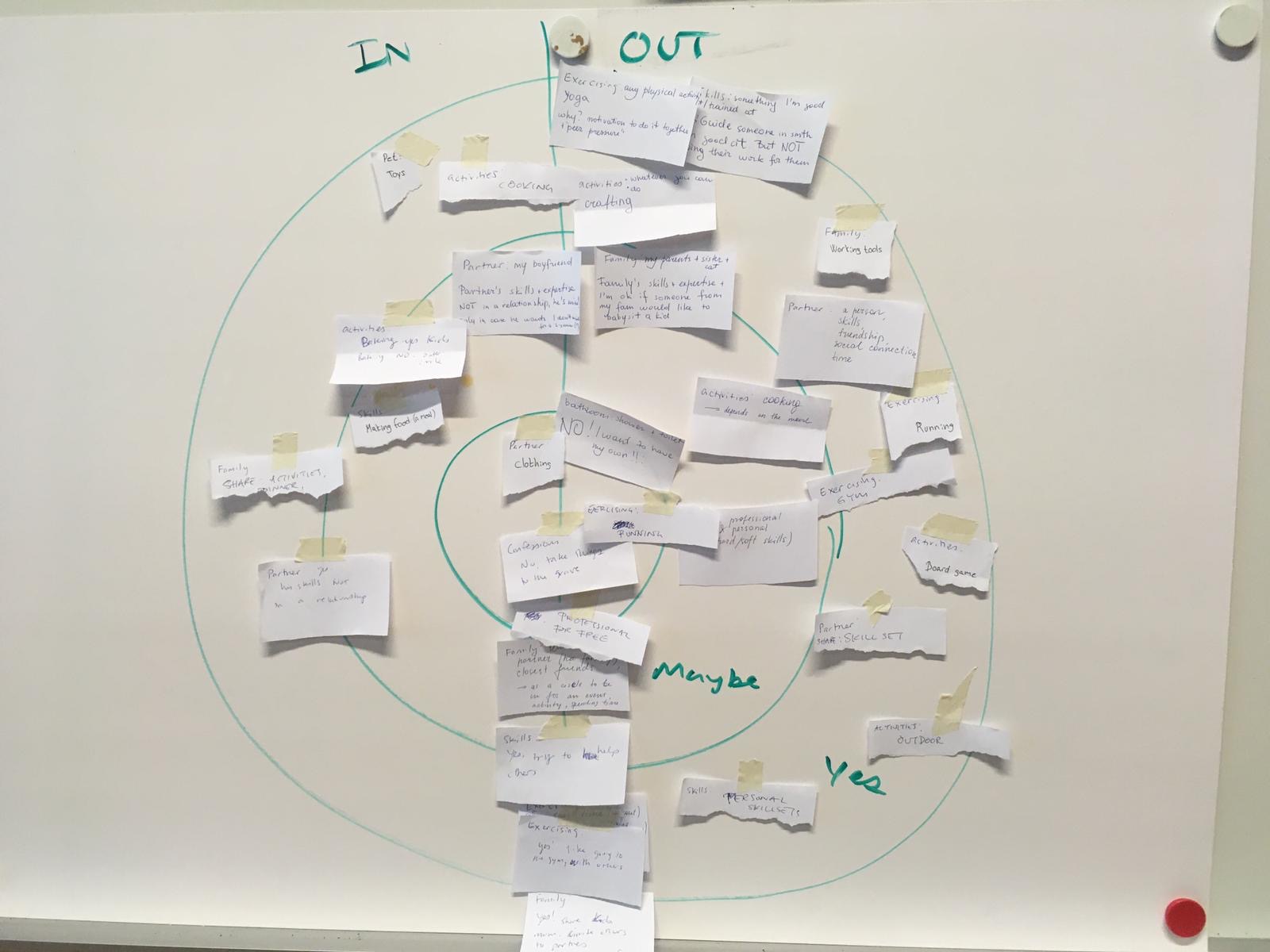
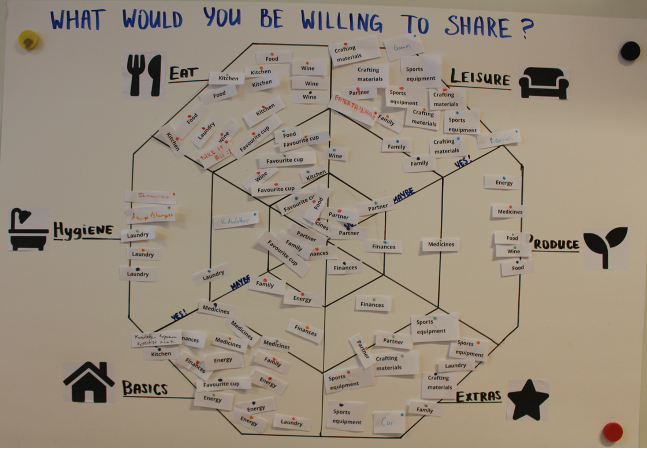
• 1st - a diagram with proposed and blank words for the participants to fill in answering the question "What would you be willing to share?"; 
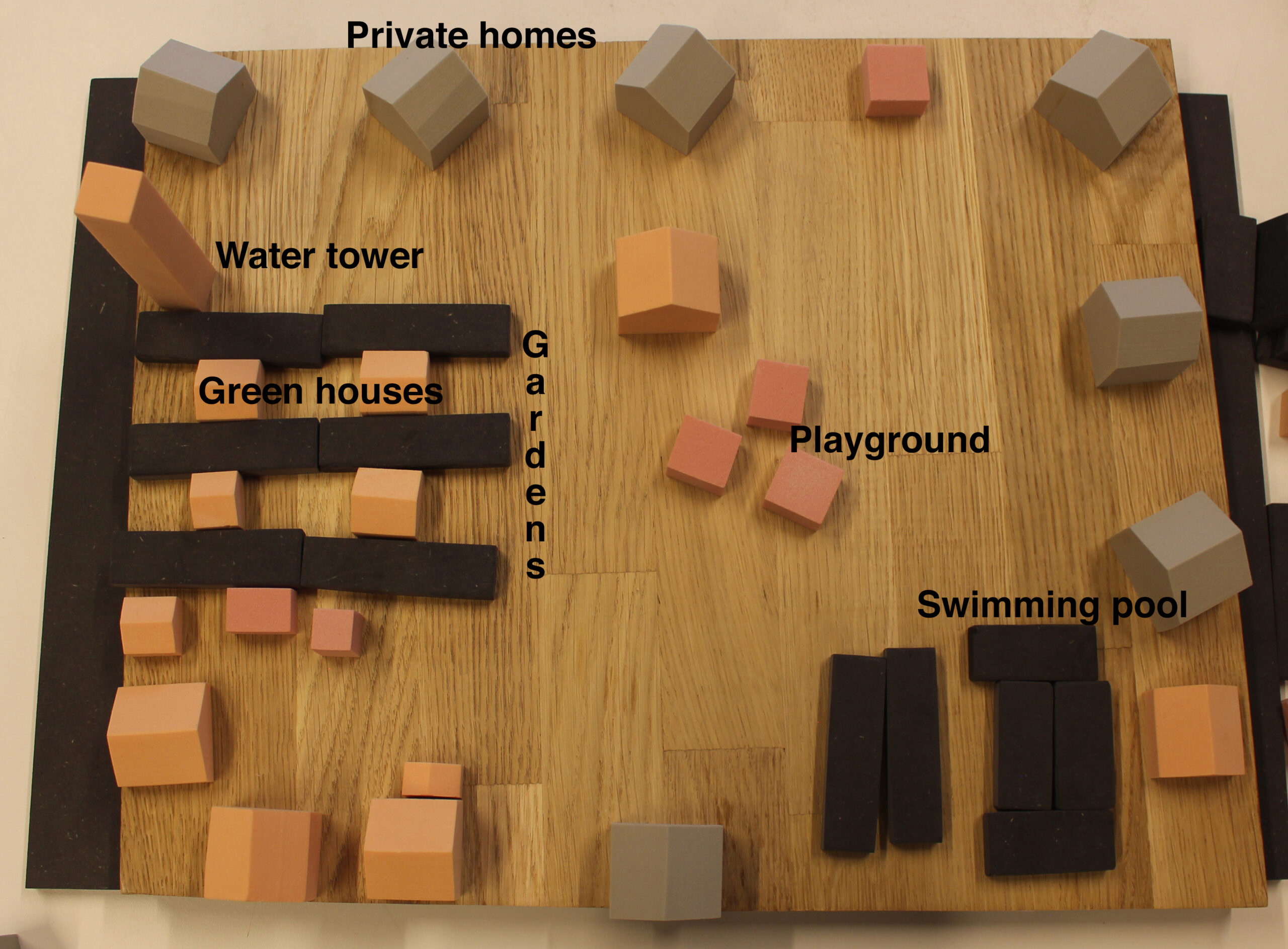
• 2nd - a board game with blocks to build envisioned community together within given categories: basics, eat, leisure, hygiene, produce, and extras.
However, it turned out that these activities did not document the discussions very well, so we added different questions and small questionnaires for the participants during iteration.

Workshop 2
Workshop 2 consisted of 6 expat parents, who were acquainted with each other and met at the familiar setting for the workshop.
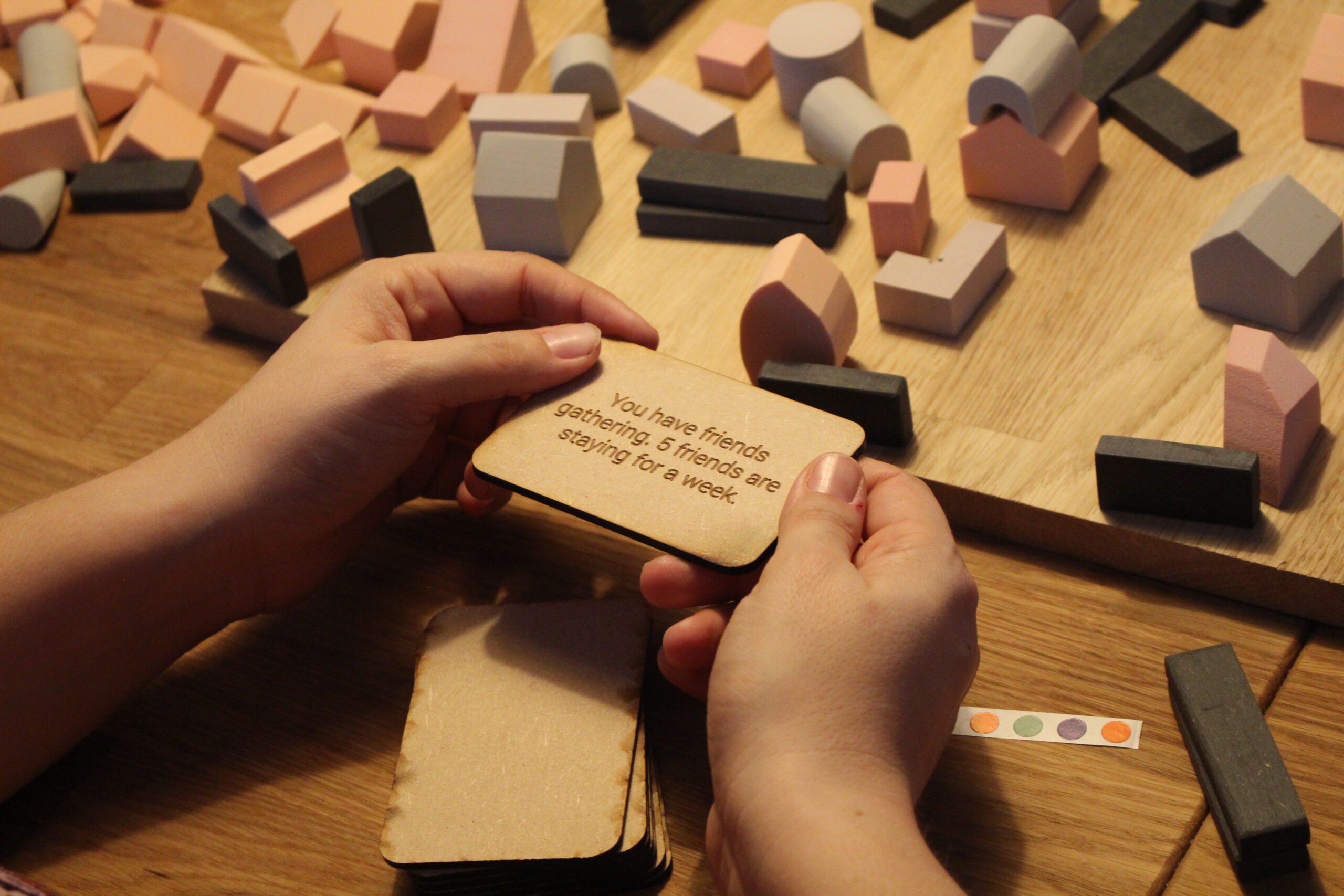
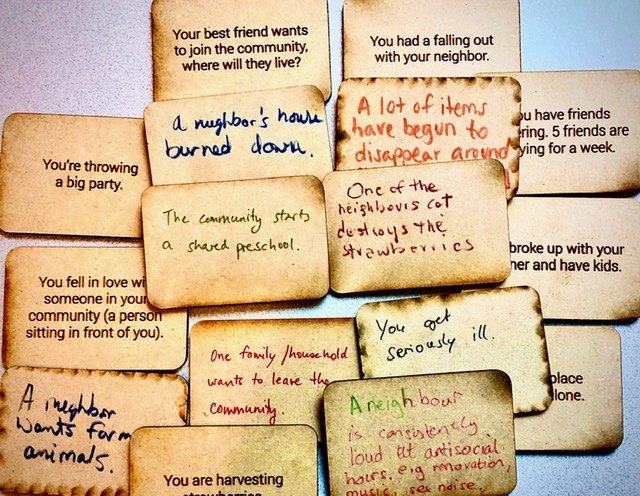
I was honoured to facilitate the final testing with great support from the team. The testing included more rounds and tasks within the activities. First, the participats had to build the community together buy using building blocks and a board. Then they were asked to reflect on what was easy or difficult to share. After that they were asked to add changes to the built community based on the situation on a card they picked as well as later mark the locations based on provided questions such as "Where would you like your community to gather?".
Workshop 1 activities and results.
Workshop 2 activities and results.

RESULT

THE TOOLKIT

The Toolkit should consist of a series of workshops with cultural probes in between, tackling Practicalities, Conflicts, and Emotions to different extend. 
It is a good ice breaker to get to know each other better and a first step in deciding whether shared living is for you by providing points to consider before starting a community. It’s a discussion starter, scenario and extreme future scenario imagination trigger with the possibility to solve given problem/scenario in the moment. It stimulates to think continuously during the workshops and gives everyone a chance to communicate. 

The first cultural probe (the ice breaker) would be sent in a package and consist of the consent form, a brief intro to the project, then the cultural probe activity.

The first workshop would include building board and a few rounds of facilitated discussions. However, after that workshop, each player would receive another probe (postcards), with the task of writing a short entry after each workshop in a diary and 2-sided feedback postcards with perforated sides: one to keep, one to send to facilitators.

The second workshop would consist of a role-playing activity, where each participant would get an opportunity to channel imagination and think outside the box while picking a card with a scenario and brainstorming how to build a community based on a given scenario. At the end of this workshop, the participants would receive a cultural probe as a follow-up exercise. This is also the point where they would be asked to turn everything in for the facilitators to analyze and draw conclusions.

After the last workshop, as an informative thank you souvenir, the participants would receive something like a small token in a form of a picture or a small wooden house or a booklet.
Contents of the final Toolkit.

REFLECTIONS

What I learned

• Working with a stakeholder
• How to ask about the consent to be recorded
• How to take pictures without someone being on them
• Conduction of field trip
• Facilitation of workshops
• Peer reviewing and giving feedback for an academic paper
linkedin facebook pinterest youtube rss twitter instagram facebook-blank rss-blank linkedin-blank pinterest youtube twitter instagram